
Parity-time (PT) symmetry has attracted a lot of attention in many fields of physics in recent years. Its application is hindered by the stringent requirements on coherent gain balanced with loss.The transition from PT-symmetry to the broken PT-symmetry is through exceptional points (EPs), a singularity where both the eigenvalues and eigenvectors of the system coalesce. These EPs exhibit interesting properties for topological matter, nonreciprocal transport, optical based applications and so on. In the current project, we aim to further figure out the properties of EPs in opto-electromechanical array. The quantum concepts such as multipartite entanglement, photon/phonon nonreciprocal/topological transport, and quantum synchronization based on EPs are some interesting outputs expected from this project. Our motivation is to transfer our knowledge on PT-symmetry from optomechanics to electromechanics in order to extend this research field to the colleagues having quantum electronic background. This project constitute not only a step towards an establishment of strong collaborative network with African researchers who have a good understanding of electronic circuits, but it will lead us also to deeply explore quantum electronics.

Quantum and collective phenomena induced by PT-symmetry in opto-electromechanical array
2025
Related to this project

event
New era of physics to address local needs
The workshop aims to bring together young African physicists who are committed to working collaboratively to foster and lay down foundations of a new era of low-cost applied physics that addresses local needs.
publication
Chaos control and exceptional point engineering via dissipative optomechanical coupling
Mbokop Tchounda, Stella. R., Philippe Djorwé, P., Murielle V. Tchakui and Serge G. Nana Engo. 2024. Chaos control and exceptional point engineering via dis...
public lecture / seminar
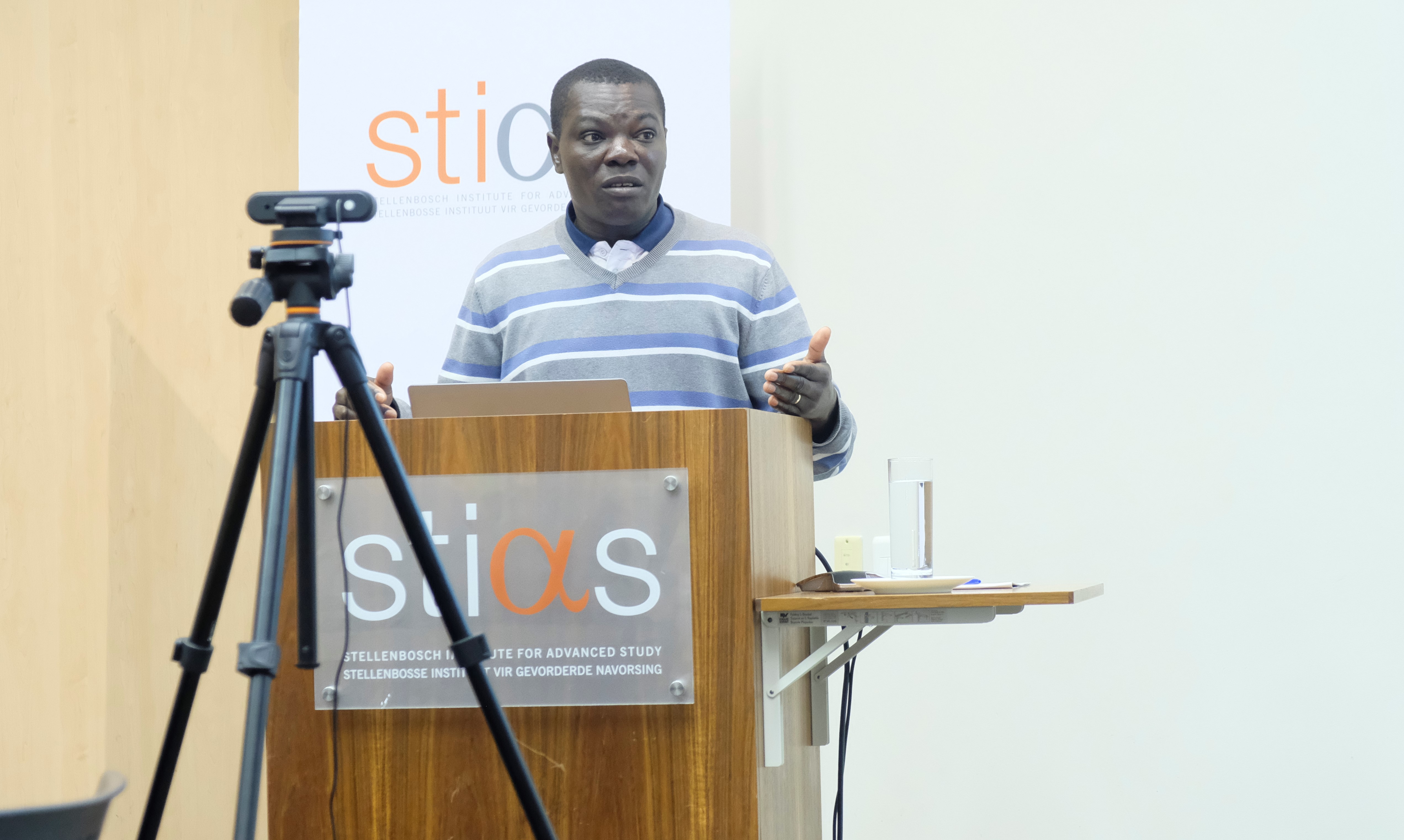
Optimising mass sensors for the tiniest objects - Fellows' seminar by Philippe Djorwé
We are all very familiar with weighing our vegetables on electronic weighing scales in supermarkets – these convert the force of a weight mass to an electric signal using sensors on the surface.

publication
Sensor Sensitivity Based on Exceptional Points Engineered via Synthetic Magnetism
Tchounda, Stella Rolande Mbokop, Philippe Djorwé, Serge Guy Nana Engo, Bahram Djafari-Rouhani. 2023. Sensor Sensitivity Based on Exceptional Points Enginee...

public lecture / seminar
Developing more sensitive mass sensors - Fellow's seminar by Philippe Djorwé
Sensors are mechanisms or devices that can convert chemical, physical and biological responses into electronic signals.

news-article
Sixth cohort of Iso Lomso Fellows selected
STIAS is pleased to announce its sixth cohort of Iso Lomso fellows and visiting scholars for applications submitted during its last call.