

Why and how did we (Homo sapiens) evolve into a species that is dependent on its ‘brains’ rather than its ‘brawn’ for our survival and successful spread across the globe? This is an old question, but recent archaeological and palaeoanthropological finds in sub-Saharan Africa, together with breakthroughs in ancient-DNA and palaeo-neurology, are dramatically changing what we thought we knew about human cognitive evolution. Based on our direct involvement with the generation on of primary knowledge about human cognition, Stone Age archaeology, experimental archaeology, neuro-archaeology and living and ancient-DNA, we aim to explore human cognitive evolution from a multi-disciplinary perspective. The core of our investigation is situated around technologies (dating from about 3.3 million years to 10 000 years ago) that were invented and used to extract a variety of foods that helped develop and nourish our increasingly energetically and cognitively ‘hungry’ brains. We flesh out our narrative by interweaving aspects of animal thinking, modern human cognition, brain-selective nutrients, the use of fire, learning and teaching, gene-culture co-evolution and our neurological evolution with the aim to produce a holistic synthesis.
Related to this project

Publication
The Nature of Culture: An Eight-Grade Model for the Evolution and Expansion of Cultural Capacities in Hominins and Other Animals
Haidle, Miriam Noël, Michael Bolus, Mark Collard, Nicholas J Conard, Duilio Garofoli, Marlize Lombard, April Nowell, Claudio Tennie, and Andrew Whiten. 201...
Publication
Still Bay Point-Production Strategies at Hollow Rock Shelter and Umhlatuzana Rock Shelter and Knowledge-Transfer Systems in Southern Africa at about 80-70 Thousand Years Ago
Högberg, Anders and Marlize Lombard. 2016. Still Bay Point-Production Strategies at Hollow Rock Shelter and Umhlatuzana Rock Shelter and Knowledge-Transfer...
Publication
Indications of Pressure Flaking More than 70 Thousand Years Ago at Umhlatuzana Rock Shelter
Högberg, Anders and Marlize Lombard. 2016. Indications of Pressure Flaking More than 70 Thousand Years Ago at Umhlatuzana Rock Shelter. South African Archa...
Publication
Bridging Theory and Bow Hunting: Human Cognitive Evolution and Archaeology
Coolidge, Frederick L, Miriam Noël Haidle, Marlize Lombard, and Thomas Wynn. 2016. Bridging Theory and Bow Hunting: Human Cognitive Evolution and Archaeolo...
Publication
Mountaineering or Ratcheting? Stone Age Hunting Weapons as Proxy for the Evolution of Human Technological, Behavioral and Cognitive Flexibility
Lombard, Marlize. 2016. Mountaineering or Ratcheting? Stone Age Hunting Weapons as Proxy for the Evolution of Human Technological, Behavioral and Cognitive...
Publication
Southern African ancient genomes estimate modern human divergence to 350,000 to 260,000 years ago
Schlebusch, Carina M., Helena Malströom, Torsten Günther, Per Sjödin, Alexandra Coutinho, Hanna Edlund, Arielle R. Munters, Mário Vicente, Maryna Steyn, Hi...
Publication
Tracking the evolution of causal cognition in humans
Lombard, Marlize and Peter Gärdenfors. 2017. Tracking the evolution of causal cognition in humans. Journal of Anthropological Sciences, 95, 219–234. https:...
Publication
The role of play objects and object play in human cognitive evolution and innovation
Riede, Felix, Niels N. Johannsen, Anders Högberg, April Nowell and Lombard, Marlize. 2018. The role of play objects and object play in human cognitive evol...
Publication
The Still Bay points of Apollo 11 Rock Shelter, Namibia: an inter-regional perspective
Lombard, Marlize and Anders Högberg. 2018. The Still Bay points of Apollo 11 Rock Shelter, Namibia: an inter-regional perspective. Azania: Archaeological R...
Publication
Causal Cognition, Force Dynamics and Early Hunting Technologies
Gärdenfors, Peter and Marlize Lombard. 2018. Causal Cognition, Force Dynamics and Early Hunting Technologies. Frontiers in Psychology, 9. https://doi.org/1...
Publication
Technology led to more abstract causal reasoning
Gärdenfors, Peter and Marlize Lombard. 2020. Technology led to more abstract causal reasoning. Biology & Philosophy, 35(4), 40. https://doi.org/10.1007...
Publication
Introduction to ‘Theoretical Pathways’: Thinking About Human Endeavour During the Middle Stone Age and Middle Palaeolithic
Högberg, Anders and Marlize Lombard. 2021. Introduction to ‘Theoretical Pathways’: Thinking About Human Endeavour During the Middle Stone Age and Middle Pa...
Article
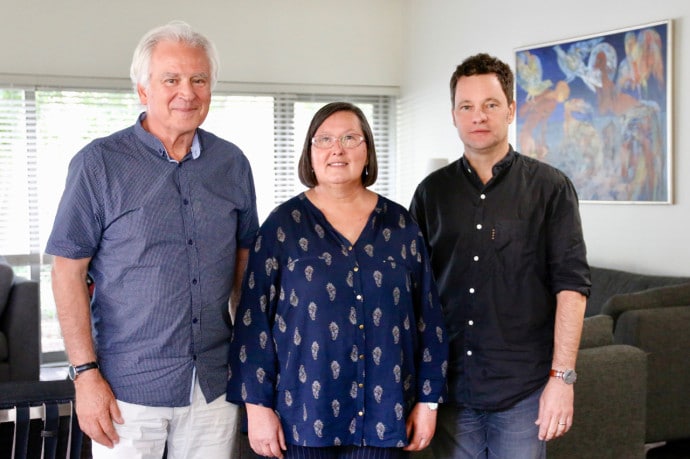
How we learnt to think like humans - Fellows' seminar by Peter Gärdenfors, Marlize Lombard and Anders Högberg
STIAS fellows Peter Gärdenfors, Marlize Lombard and Anders Högberg after their seminar on 29 November 2018 Our expanding knowledge of the hominin tree, in combination with the archaeological record of sub-Saharan Africa and the reconstruction of ancient human genomes change our understanding of human cognitive evolution.
Article
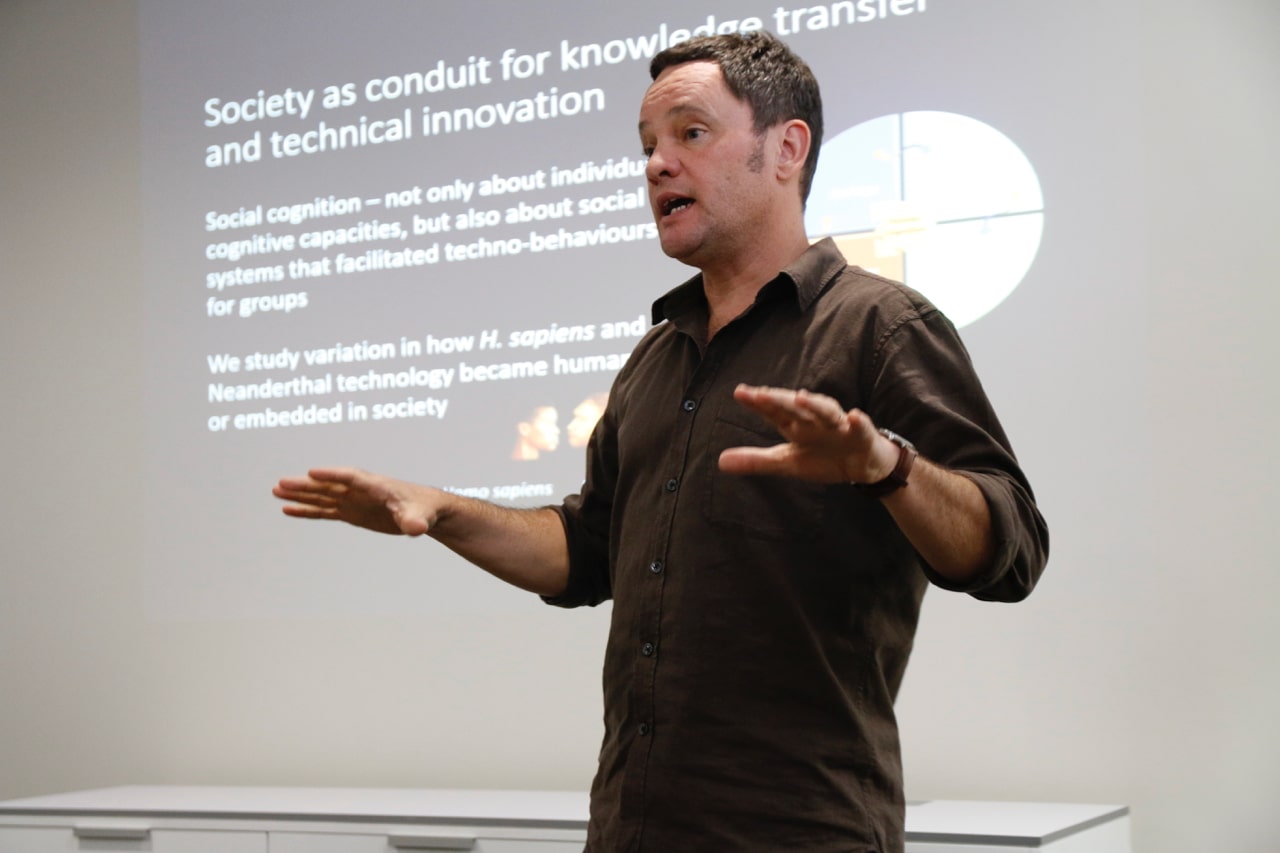
Archaeology of a hungry mind - Fellows' seminar by Marlize Lombard, Anders Högberg and Peter Gärdenfors
We suggest that a useful way to explore the evolution of human cognition between about 300 000 and 50 000 years ago is to think of it in terms of a co-evolutionary feedback loop between aspects of biology, technology, society and ecology.
Article
Minds on Fire - Fellows' seminar by Marlize Lombard, Anders Högberg and Peter Gärdenfors
Cognitive and archaeological aspects of hunter-gatherer fire making The art of making fire was described by Darwin as one of the greatest achievements of humankind.